Rourke Lead Rescue
A missed call is a $400–$1,500 job walking to the next plumber. This closes the hole — and recovers ~$7,600/week.
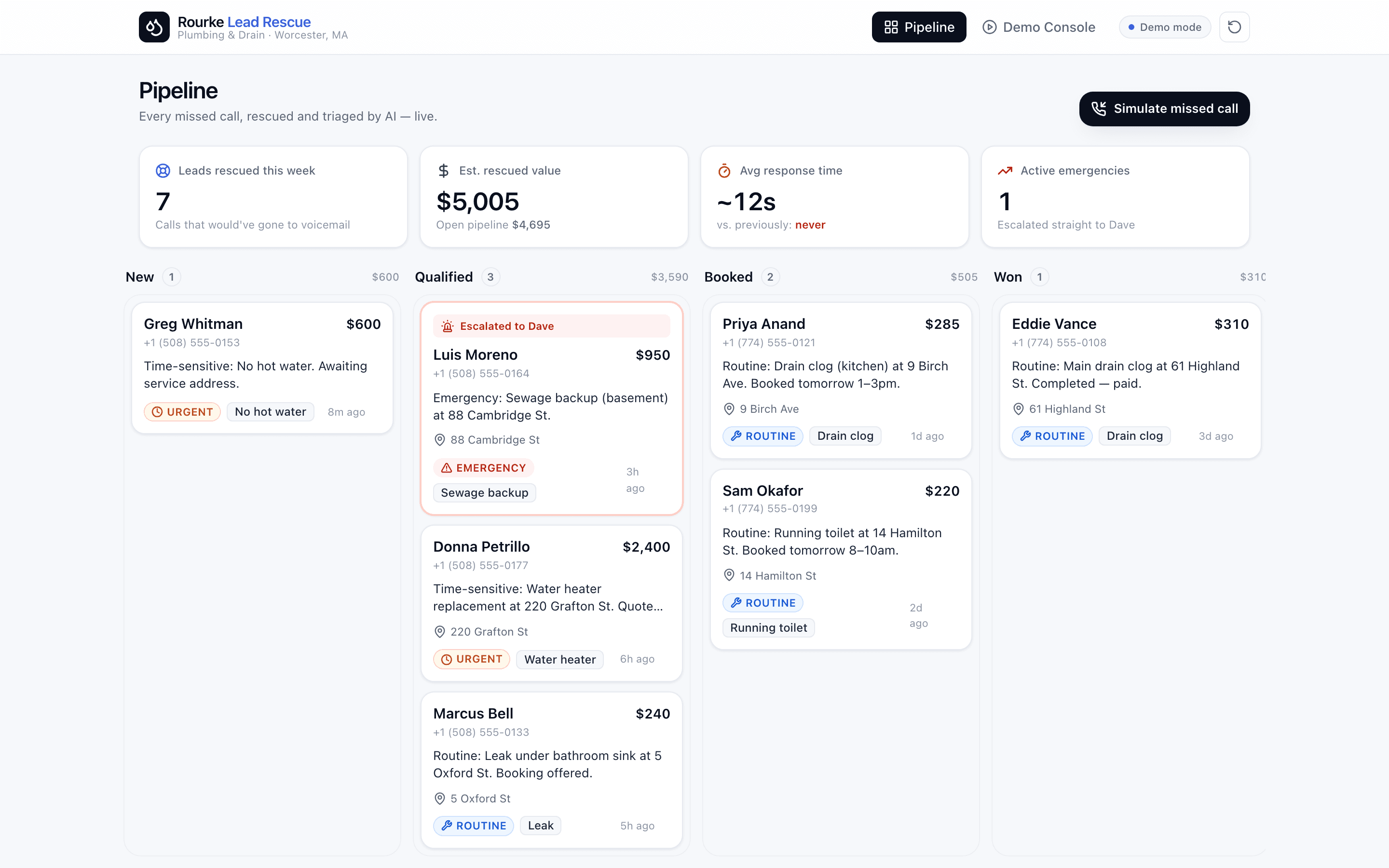
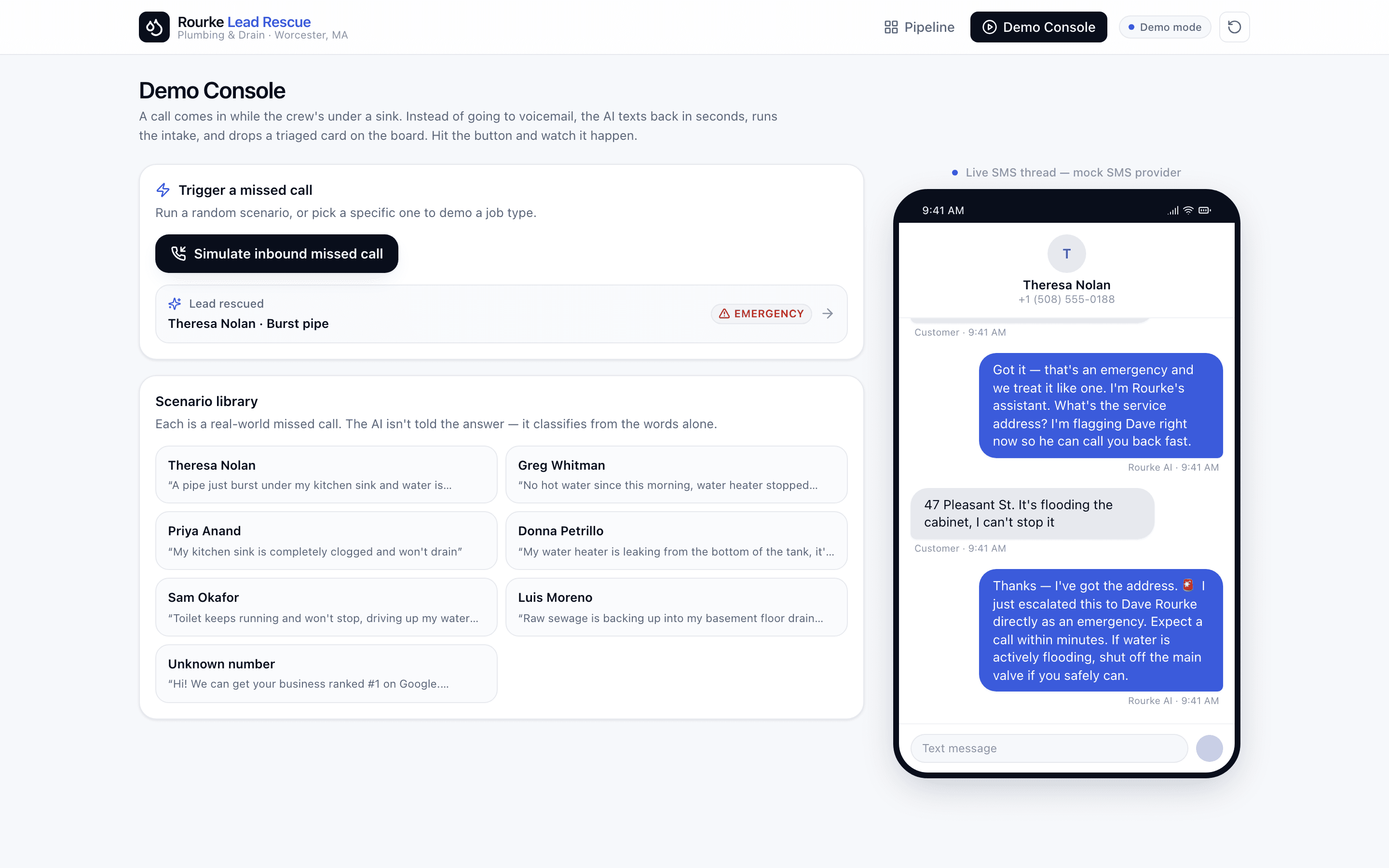
The live demo runs fully keyless — the AI is a deterministic rules engine, SMS is simulated in the phone panel, and "realtime" is an in-browser store (localStorage + BroadcastChannel). The board is seeded with a week of sample leads. Set env vars to swap any layer to OpenAI, Twilio, or Supabase without touching the UI.
The problem
A 4-truck plumbing shop misses ~30% of inbound calls — crews are under sinks, not by the phone. Of ~80 calls a week, ~24 go unanswered; ~17 of those are real jobs at ~$450 each. That's roughly $7,600 a week dialing the next plumber on Google before the owner even knows they called. The phone is the top of the funnel, and the funnel has a hole in it.
The approach
I built the loop that closes it. A missed call triggers an AI text-back in ~12 seconds; a conversational SMS intake gathers the details; an AI rules engine classifies job type and urgency and extracts structured fields; emergencies escalate straight to the owner's phone, routine jobs get offered a booking slot, and every conversation becomes a triaged card on a live pipeline. One number sits on top of it all — rescued revenue this week.
The outcome
A mobile-first product that turns the shop's biggest leak into recovered revenue, and ships with a deliberate engineering twist — it runs and deploys with zero external keys. The AI, SMS, and database layers each ship a deterministic mock behind the same interface as the real thing, so the entire loop is explorable in front of a prospect with nothing to sign up for, and graduates to OpenAI / Twilio / Supabase one env var at a time.
The problem, quantified
Rourke Plumbing & Drain is a realistic stand-in for the kind of small operator I build for — a four-truck shop run from the cab of a truck, no CRM, leads living in a paper notebook. The math is brutal and typical:
| Inbound calls / week | ~80 |
| Missed (crew on a job) | ~30% → 24 calls |
| Of those, real jobs | ~70% → ~17 jobs |
| Average job value | ~$450 |
| Revenue leaking out the back / week | ≈ $7,600 |
Every missed caller dials the next plumber before the shop ever knows they rang.
Before / after
| Before | After | |
|---|---|---|
| Missed call | voicemail, deleted unheard | AI texts back in ~12s |
| Triage | none | job type + urgency, automatic |
| Emergencies | found out hours later | escalated to the owner in seconds |
| Routine jobs | lost | booking slot offered on the spot |
| Record | paper notebook | live pipeline card + full transcript |
| Response time | never | ~12 seconds |
The product sells one number — rescued revenue this week — and everything else exists to push it up.
What I built
Four screens, mobile-first, alive on first load with a seeded week of leads.
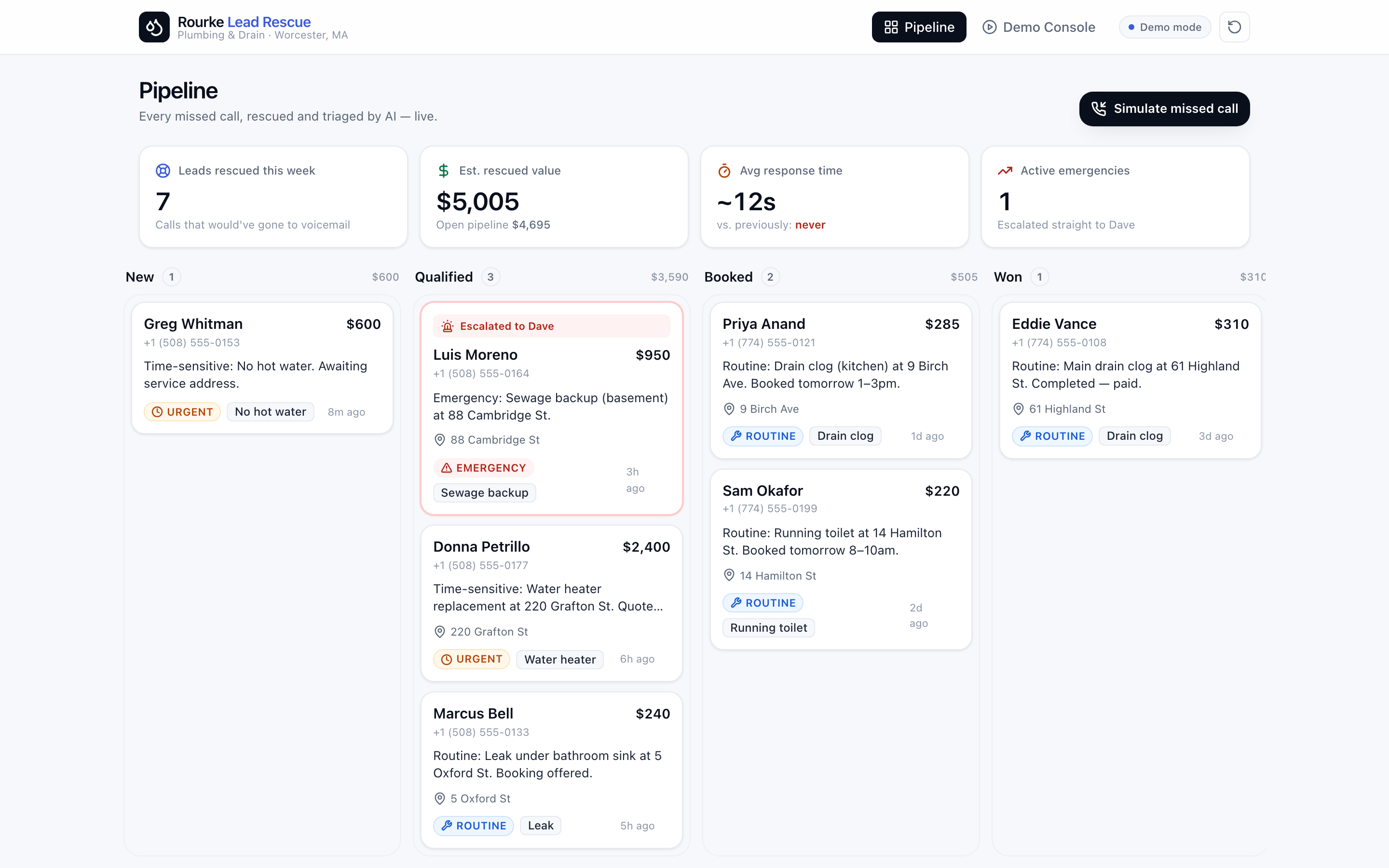
The pipeline — a Kanban board (New → Qualified → Booked → Won) with a metrics strip on top: leads rescued, estimated rescued value, average response time vs. never, and active emergencies. Emergencies are flagged red and pinned; spam is auto-filtered into a tray.
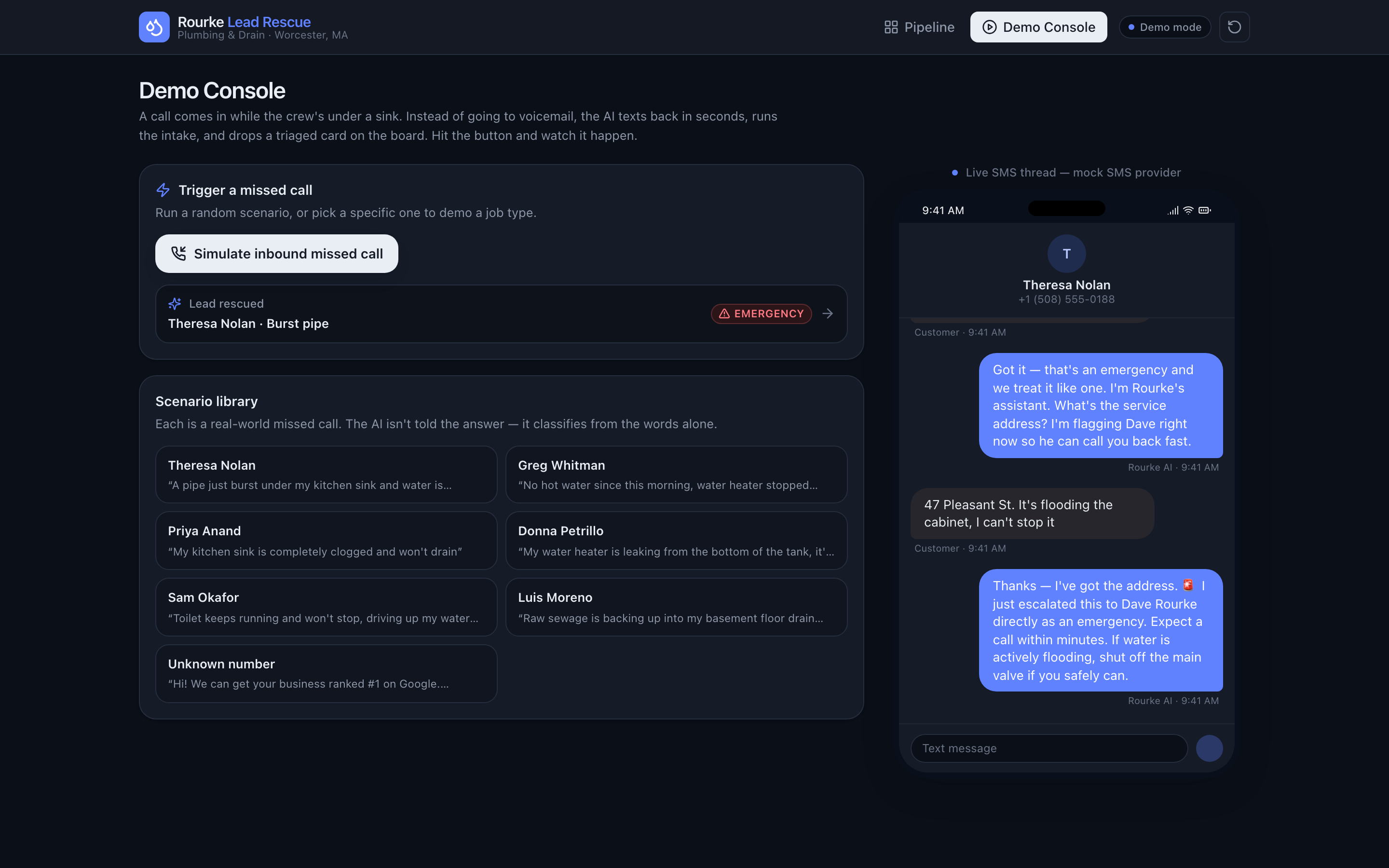
The demo console — hit Simulate inbound missed call and watch the whole loop run live in an iMessage-style phone simulator: the AI texts back, the customer replies, the job gets classified, and within seconds a triaged card lands on the board. Here it is catching a burst-pipe emergency and escalating it:
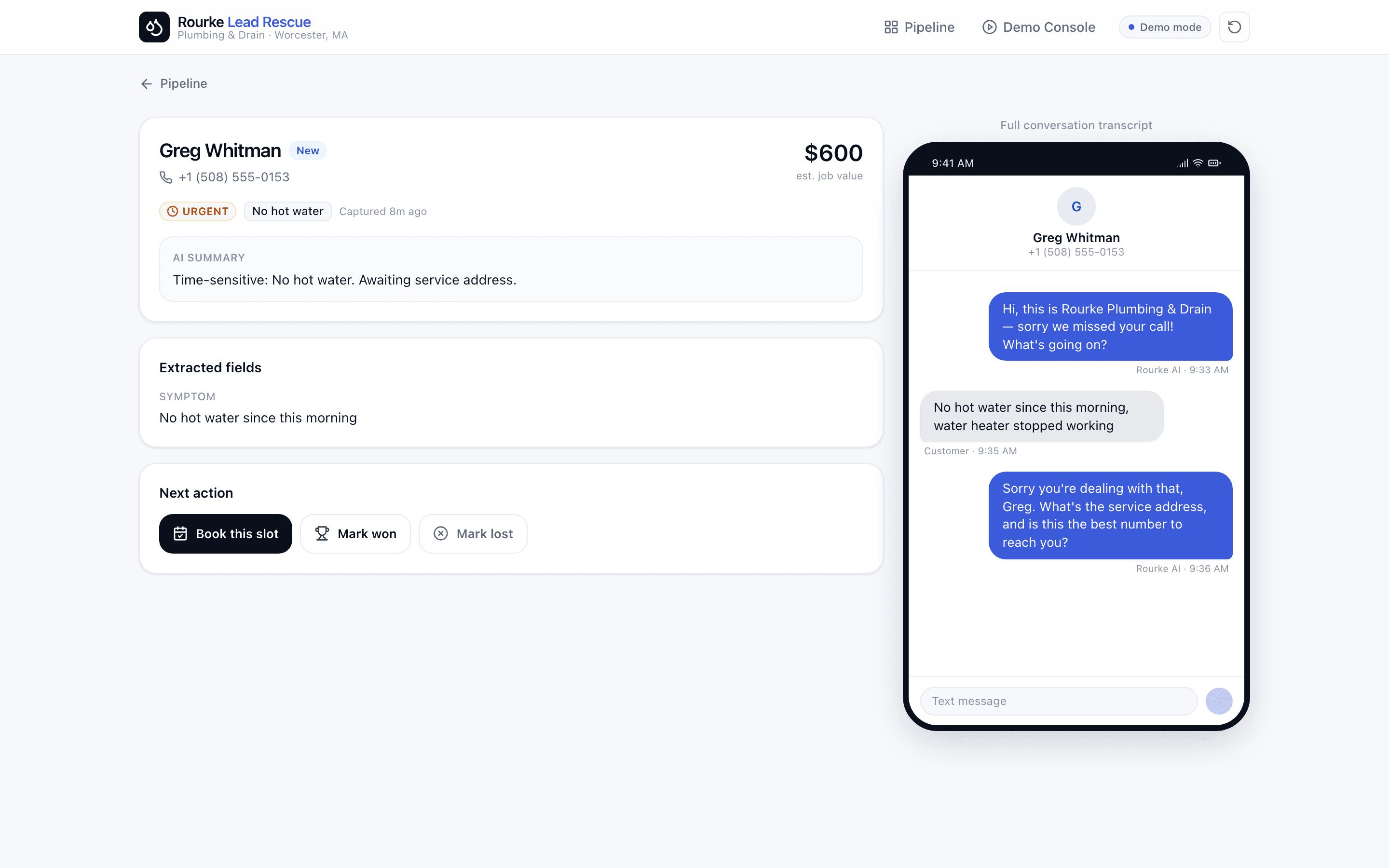
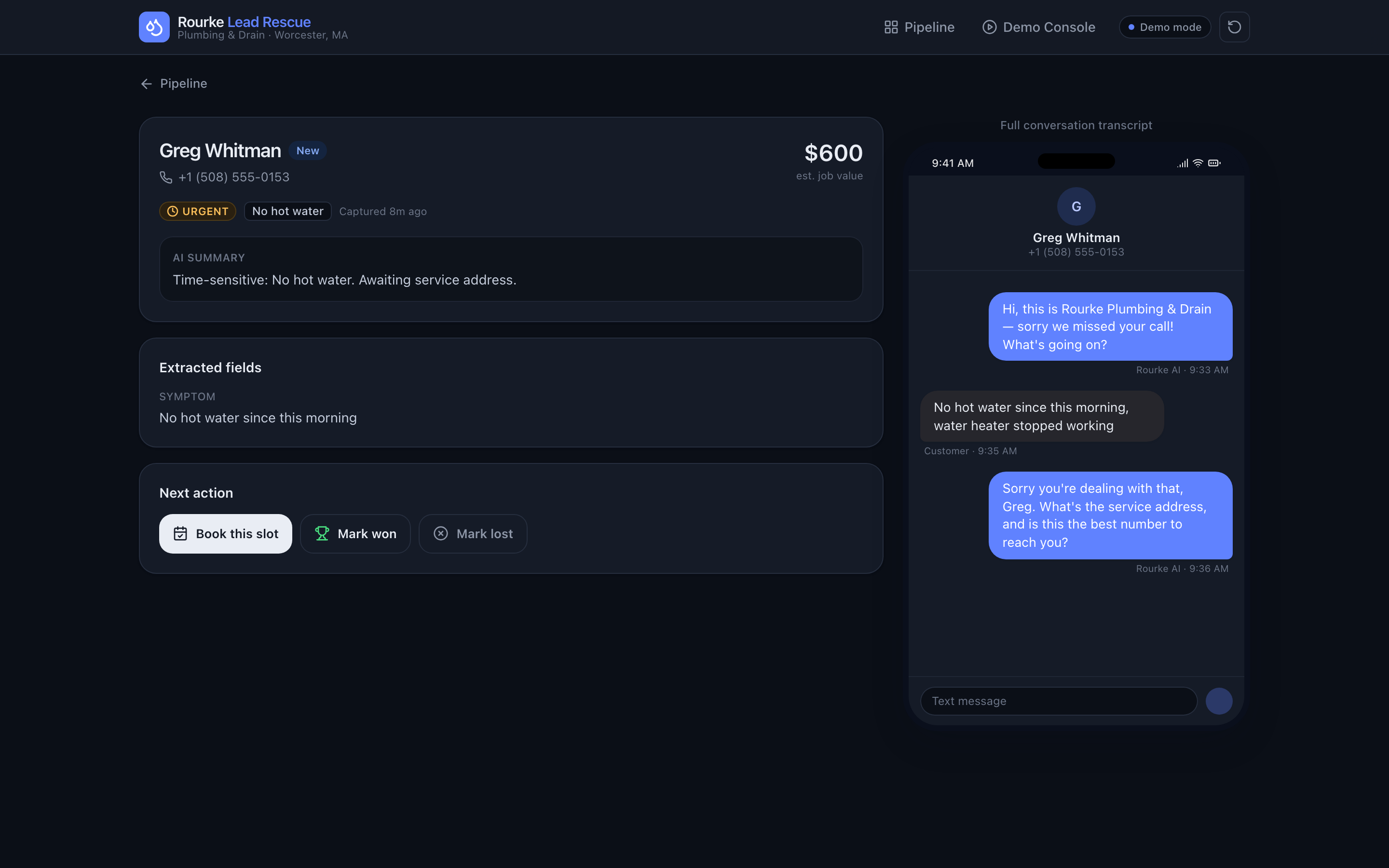
The lead detail — the full transcript, the structured fields the AI pulled out of the customer's words, and the two actions that matter: Book this slot and Escalate to the owner.
Dark mode is automatic — a CSS-variable flip on prefers-color-scheme, no flash —
and the whole thing is an installable PWA.
The architecture — and the decision behind it
The interesting constraint was self-imposed: I wanted a Supabase-backed, realtime product that anyone could deploy and explore with zero keys. Those two goals fight each other. I resolved it by making the backend a seam, not an assumption.
                    ┌──────── React store (loads a snapshot, subscribes,
                    │         exposes actions) ────────┐
                    │              │                   │
              AIProvider      SMSProvider          DataProvider
          ┌──────┴──────┐  ┌──────┴──────┐    ┌────────┴────────┐
          │ mock (rules)│  │ mock (→ UI) │    │ local (browser) │ ← default, zero keys
          │ openai      │  │ twilio      │    │ supabase (PG+RT)│ ← set env to enable
          └─────────────┘  └─────────────┘    └─────────────────┘
Three clean interfaces — AIProvider, SMSProvider, DataProvider — each with a
deterministic mock and a real implementation behind the identical shape:
- AI isn't a stub — it's a small rules engine that classifies job type and urgency from an ordered keyword table (sewage/burst → emergency, no-hot-water → urgent, clog/leak → routine, solicitation → spam), extracts address and onset by regex, and composes the next turn-aware SMS. Same transcript in, same JSON out — so the demo is reproducible in front of a prospect.
- Data defaults to an in-browser store; realtime is
localStorage+BroadcastChannel, so triggering a simulation in one tab animates a card onto the board in another. Wire up Supabase and the same store subscribes topostgres_changesinstead — the UI never knows the difference. - SMS writes to the phone simulator by default; the real path is Twilio.
The intake orchestration is a pure function with every side effect injected, so it reads like the product spec: create the lead, text back, gather info, classify, then escalate or book.
That's the senior call I'd want a peer to notice: not "I used Supabase," but "I designed the boundary so the product is honest to demo and one env var from production."